

Resources
What are the Social Determinants of Health?
The Social Determinants of Health (SDH) are the non-medical factors that influence health outcomes. They are the conditions in which people are born, grow, work, live, and age, and the wider set of forces and systems shaping the conditions of daily life. These forces and systems include economic policies and systems, development agendas, social norms, social policies and political systems.
The SDH have an important influence on health inequities - the unfair and avoidable differences in health status seen within and between countries. In countries at all levels of income, health and illness follow a social gradient: the lower the socioeconomic position, the worse the health.
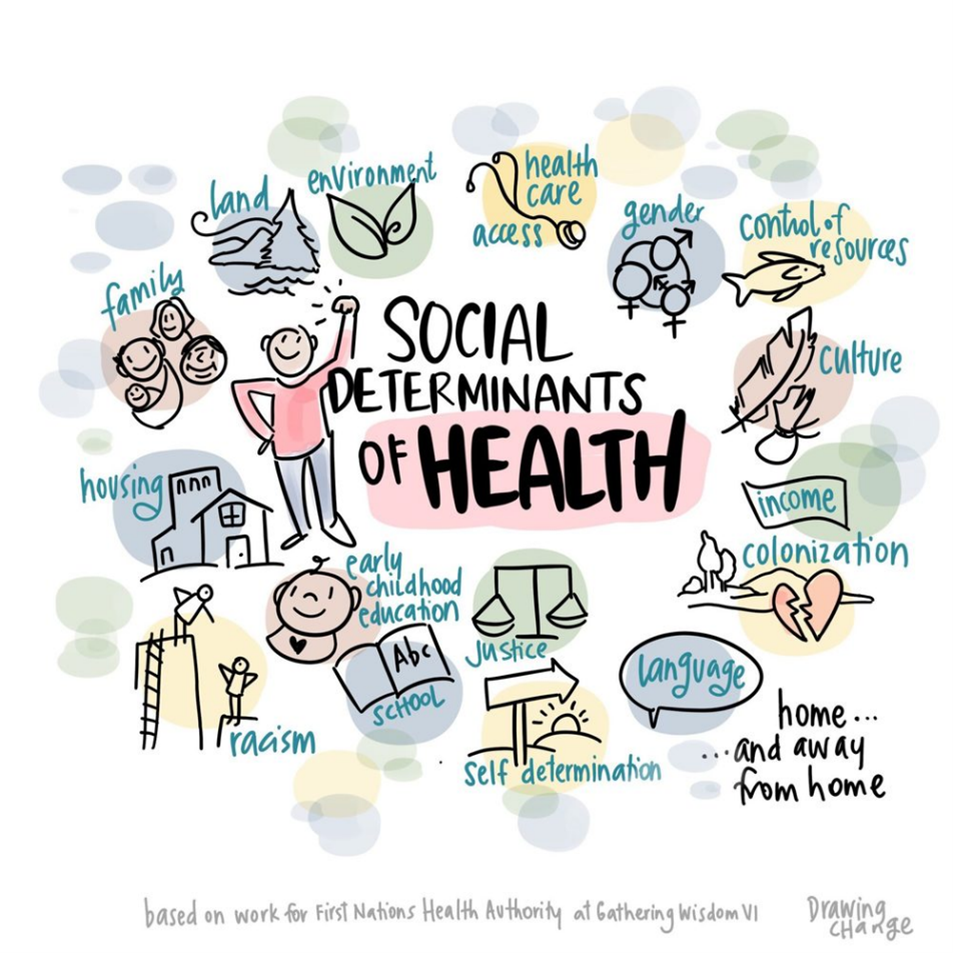
The following list provides examples of the social determinants of health, which can influence health equity in positive and negative ways:
Income and social protection
Education
Unemployment and job insecurity
Working life conditions
Food insecurity
Housing, basic amenities and the environment
Early childhood development
Social inclusion and non-discrimination
Structural conflict
Access to affordable health services of decent quality.
-
Indigenous communities have experienced centuries of colonization, forced assimilation, displacement from ancestral lands, and cultural genocide. This historical trauma continues to affect mental health, social cohesion, and community well-being.
-
Indigenous communities often face higher rates of poverty, unemployment, and limited access to economic opportunities compared to non-indigenous populations. Economic marginalization can lead to inadequate housing, food insecurity, and limited access to healthcare services.
-
The erosion of traditional cultural practices and languages due to historical policies and ongoing societal pressures can contribute to a loss of identity and connection to ancestral lands. Cultural disconnection can negatively impact mental health and well-being.
-
Indigenous communities may face barriers to accessing quality healthcare services, including geographical isolation, lack of healthcare infrastructure, cultural insensitivity among healthcare providers, and limited availability of services tailored to indigenous needs.
-
Many indigenous communities experience disproportionate exposure to environmental hazards such as pollution, unsafe drinking water, and climate change impacts. These environmental factors can contribute to higher rates of respiratory illnesses, waterborne diseases, and other health issues.
-
Indigenous peoples often face discrimination and racism in various aspects of life, including healthcare, education, employment, and the justice system. Racism contributes to stress, trauma, and mistrust of institutions, negatively impacting health outcomes.
-
Disputes over land rights and resource extraction can lead to environmental degradation, loss of traditional livelihoods, and disruption of cultural practices such as hunting, fishing, and gathering. These challenges can affect food security, economic stability, and overall community health.
-
Early experiences, including prenatal care, early childhood education, and parental support, can have a significant impact on lifelong health and well-being.
Why is it important to understand the Social Determinants of Health within our own community? What role does it play in our health and the survey?
The Community Health Survey is comprehensive and evaluates all the factors at play in day-to-day life. There are many things to consider when looking at the overall “big picture” of health.
Want to learn more? Watch the YouTube video below!
What is the Value of Research?
Research is like the compass that guides communities toward progress and prosperity. Here's how it adds value and enhances communities:
-
Research fuels innovation by uncovering new knowledge, technologies, and methodologies. Whether it's in medicine, technology, or social sciences, research provides the foundation for advancements that improve the quality of life. For instance, medical research leads to the development of new treatments and cures for diseases, enhancing community health.
-
Communities face numerous challenges, from environmental issues to economic disparities. Research helps identify the root causes of these problems and provides evidence-based solutions. For example, research on sustainable energy sources helps communities reduce their carbon footprint and combat climate change.
-
Policymakers rely on research to make informed decisions that benefit communities. Whether it's crafting public health policies or urban planning initiatives, research provides the data and insights necessary to devise effective strategies.
-
Research contributes to education by expanding our understanding of various subjects and disseminating knowledge to the broader community. It empowers individuals to make informed choices and participate actively in civic life.
-
Research drives economic growth by fostering entrepreneurship, attracting investment, and creating job opportunities. Communities with thriving research institutions often experience higher levels of economic development and prosperity.
-
Research in the humanities and social sciences enriches communities by preserving cultural heritage, documenting history, and fostering intercultural understanding. It helps communities appreciate their diversity and promotes social cohesion.
-
Research in healthcare and public health plays a crucial role in improving community health outcomes. From disease prevention to healthcare delivery, research informs strategies to enhance the well-being of individuals and communities.
Research is indispensable for the advancement and well-being of communities. It empowers us to tackle challenges, seize opportunities, and build a better future for everyone.
-
YES. We recognize that not all Six Nations community members have status cards or are registered under the Indian Act. As long as you belong to Six Nations, are 16+, and live within the identified areas (Six Nations, Brant, Norfolk, Haldimand, Hamilton, Niagara), you can participate in the Onkwehón:we Health Check-In.
-
YES. Some non-Native people do reside on Six Nations with their Native partners/spouses/families. As long as you live on the Six Nations reserve and are age 16+, you can participate in the Onkwehón:we Health Check-In.
-
The Six Nations Ethics Board has only approved this project for those categorized as “adults”, which normally refers to those age 18+. We adjusted this age down to age 16+ as we recognize there are lots of community members younger than 18 who experience life as adults due to the demands of work, school, children, caretaking, etc. We do plan to develop a child and youth-focused survey in the future that would include younger Six Nations community members.
-
Our survey staff are trained in the Fundamental Principles of OCAP, and the data is retained and protected by Six Nations of the Grand River. OCAP refers to "Ownership, Control, Access, and Possession." This framework is used to guide the management, protection, and sharing of Indigenous data and information. It recognizes the rights of Indigenous communities to own, control, and manage their data and information according to their cultural protocols, values, and priorities. Learn more about OCAP here.
-
Informed consent is a process of communication between a researcher and a potential participant in which the researcher provides adequate and valuable information about the study, its risks and benefits, and the participant voluntarily agrees to participate. It is a cornerstone of ethical research involving human subjects and is intended to protect the rights and welfare of participants. Consent is voluntary, informed and ongoing.